
The rain started somewhere between Fort William and Glencoe. Not the polite drizzle I had been warned about, but proper sheets of water that turned the valley floor silver and the surrounding peaks into silhouettes. I pulled the car over at the Three Sisters viewpoint, stepped outside into the wind, and understood immediately why people call this place mystic. There is something in the Highlands that photographs cannot carry. The scale, the silence, the sense that the landscape has been here forever and does not particularly care whether you showed up or not.
The Scottish Highlands are not a place you visit for comfort or convenience. You visit because something in the images called to you, some combination of moody glens, ruined castles, and single-track roads disappearing into cloud, and you needed to know whether the reality could match the feeling those images created. It can. It does. This guide covers everything you need to plan that trip: the route from Edinburgh, the driving logistics, the stops that matter, and the ones that waste your time.
Table of Contents
- Why Travellers Are Calling the Scottish Highlands Mystic
- Edinburgh to the Highlands: Your Day-by-Day Route
- The Driving Mistake Everyone Makes
- Isle of Skye or Glencoe: Which Highlands Stop Wins?
- The Castles, Lochs, and Glens Worth Stopping For
- Highlands Photography: How to Capture the Mood
- When to Go and What the Weather Actually Does
- Practical Planning: Budget, Accommodation, and Getting Around
- FAQ
Why Travellers Are Calling the Scottish Highlands Mystic
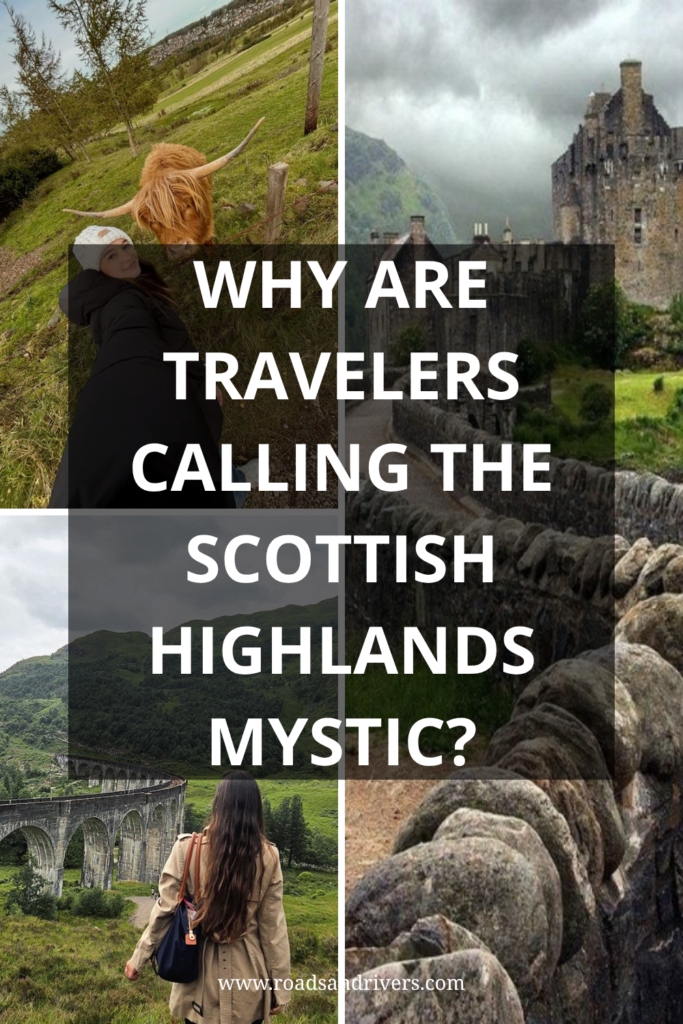
The Scottish Highlands occupy a particular place in the travel imagination. They sit somewhere between destination and feeling, a landscape that has been the backdrop for legends, literature, and cinema for centuries. The word that keeps appearing in trip reports, social media captions, and Pinterest boards is “mystic,” and for once the adjective is not overselling it.
The Highlands cover roughly 25,000 square kilometres of northwest Scotland, an area larger than Wales with a population density lower than almost anywhere else in Europe. Outside of Inverness (the only city), you are looking at villages of a few hundred people, stretches of single-track road with passing places, and views that repeat the same three elements in endlessly different combinations: mountain, water, cloud.
What makes it feel mystic rather than simply remote is the light. Scotland sits at a latitude where the sun hangs low for most of the year, creating long golden hours in the morning and evening that turn ordinary hillsides into something cinematic. Add mist that clings to the valleys, rain that shifts from heavy to soft within minutes, and the occasional break of pure blue sky above a castle ruin, and you have a landscape that feels emotionally charged in a way that most destinations do not.
The Highlands are also one of the few places in Europe where you can drive for an hour without seeing another car, stop at a viewpoint with no one else there, and walk into a landscape that looks exactly as it did 500 years ago. In an era of overtourism and Instagram queues, that solitude is worth more than most people realise.
Read more: Edinburgh Travel Guide: Best Things To Do in Scotland’s Capital for a complete guide to spending 2-3 days in Edinburgh before heading north.
Edinburgh to the Highlands: Your Day-by-Day Route
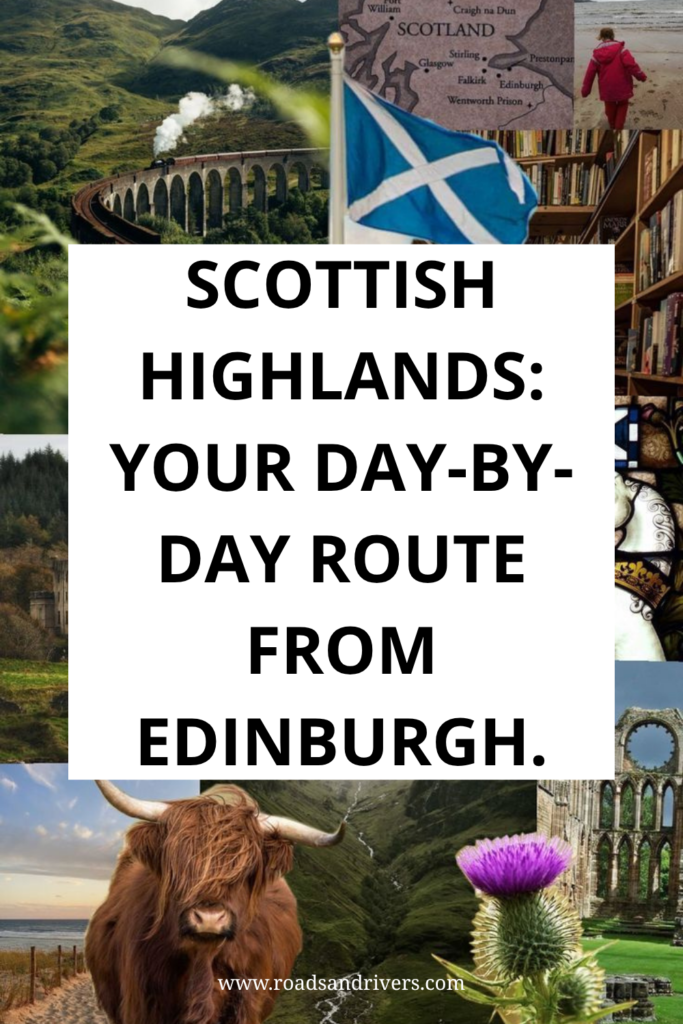
Most Highlands trips start in Edinburgh and loop north through the central Highlands, west to the coast, and back. Here is the route that covers the essential stops in 5-7 days without feeling rushed.
Day 1: Edinburgh to Glencoe (3.5 hours driving)
Leave Edinburgh in the morning and drive north through Stirling (optional stop for the castle) and along the western shore of Loch Lomond. The landscape shifts gradually from lowland farmland to Highland moorland as you approach Rannoch Moor. Arrive in Glencoe by late afternoon and spend the evening walking into the valley as the light fades.
Stay in or near Glencoe village. Options range from the Glencoe Independent Hostel (budget) to the Kingshouse Hotel at the eastern end of the valley (mid-range, recently renovated, excellent bar).
Day 2: Glencoe and Ben Nevis Area
A full day exploring Glencoe Valley. Walk the Lost Valley trail (3-4 hours, moderate), drive through the glen stopping at the Three Sisters viewpoint and the Meeting of Three Waters, and if conditions allow, take the Steall Falls walk near Fort William for one of the best waterfalls in Scotland.
Day 3: Glencoe to Isle of Skye (3 hours driving)
Drive west from Fort William along the Road to the Isles, crossing the Glenfinnan Viaduct (yes, the one from the films) and passing through some of the emptiest landscape in Britain. Cross the Skye Bridge onto the island and base yourself in Portree, the main village.
Day 4: Isle of Skye
A full day on Skye. The Old Man of Storr (2-hour hike), the Fairy Pools (easy walk, cold water, bring a towel if you are brave), and Neist Point lighthouse for sunset if the weather cooperates. Skye demands a full day minimum. Two is better.
Day 5: Skye to Inverness (3.5 hours driving)
Drive east from Skye across the mainland, through Glen Shiel and along Loch Ness to Inverness. Stop at Eilean Donan Castle on the way. It is the most photographed castle in Scotland for good reason: three lochs converge behind it and on a moody day it looks like it was placed there by a film set designer.
Day 6: Inverness and the Northern Highlands (optional)
If you have a sixth day, drive the stretch from Inverness north along the coast toward Durness or John o’Groats. This is the NC500 territory: less visited, more raw, and spectacularly empty. Otherwise, drive back to Edinburgh (3.5 hours on the A9) or fly out from Inverness airport.
Pro tip: Do not try to do this route in fewer than 5 days. The Highlands reward slow driving and spontaneous stops. Rushing through them defeats the purpose entirely.
The Driving Mistake Everyone Makes
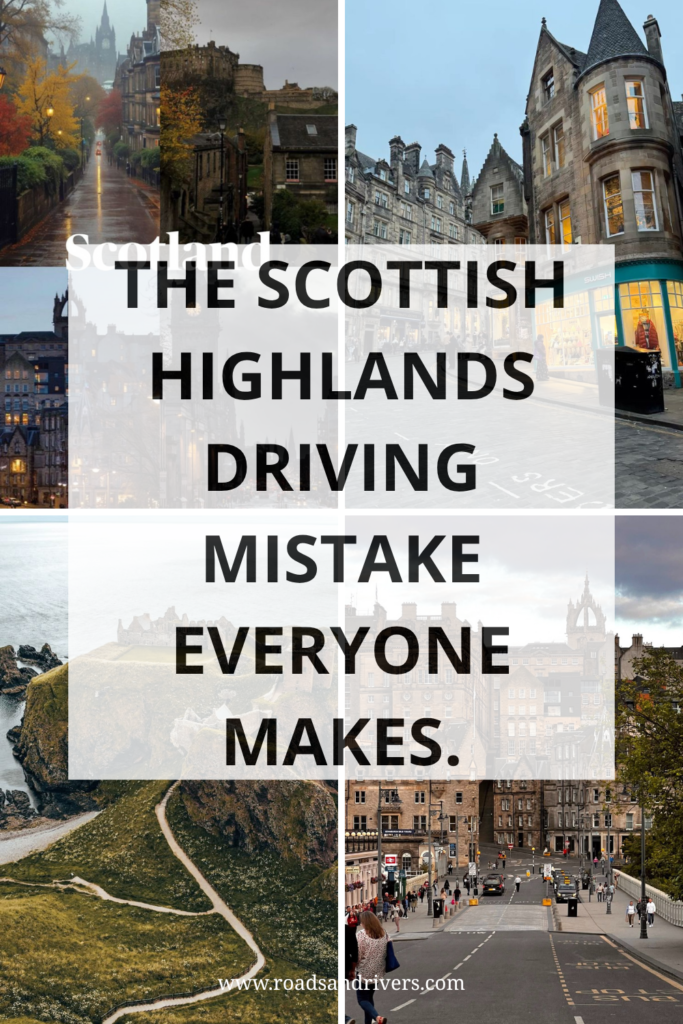
The single biggest mistake first-time Highlands visitors make is underestimating driving times. Google Maps says Glencoe to Portree is 2.5 hours. In reality, with single-track roads, sheep on the road, photo stops, and the simple fact that you will want to pull over every 15 minutes because the view has changed again, that drive takes 4-5 hours.
Single-track roads are the defining feature of Highland driving and they deserve respect. These are roads wide enough for one car, with passing places every few hundred metres marked by diamond-shaped signs. The etiquette is simple: if the passing place is on your left, pull into it. If it is on your right, stop and let the oncoming car pull in. Do not stop in the passing place itself if you are not yielding. Wave to acknowledge the other driver. This system works beautifully once you understand it but causes panic for drivers who have never seen it before.
Other driving notes worth knowing:
Petrol stations are sparse. Fill up whenever you see one. There are stretches of 40-50 miles in the northwest Highlands with no fuel available. Do not assume your phone will find one. Signal is unreliable.
Sheep have right of way. This is not a joke. Highland sheep wander across roads without any sense of urgency or awareness of vehicles. Slow down, wait, and do not honk. They will move eventually.
Daylight varies dramatically by season. In June, Scotland has 18 hours of usable daylight. In December, you get about 7 hours. Plan your driving days around sunset times, especially if you are visiting in autumn or winter.
Left-hand driving. If you are from a country that drives on the right, the combination of left-hand driving, narrow single-track roads, and unfamiliar terrain requires extra attention. Practise in Edinburgh before heading into the Highlands.
For more on planning a driving-focused trip, the guide to planning outdoor trips covers the gear and route-planning essentials that apply to any adventure trip.
Isle of Skye or Glencoe: Which Highlands Stop Wins?
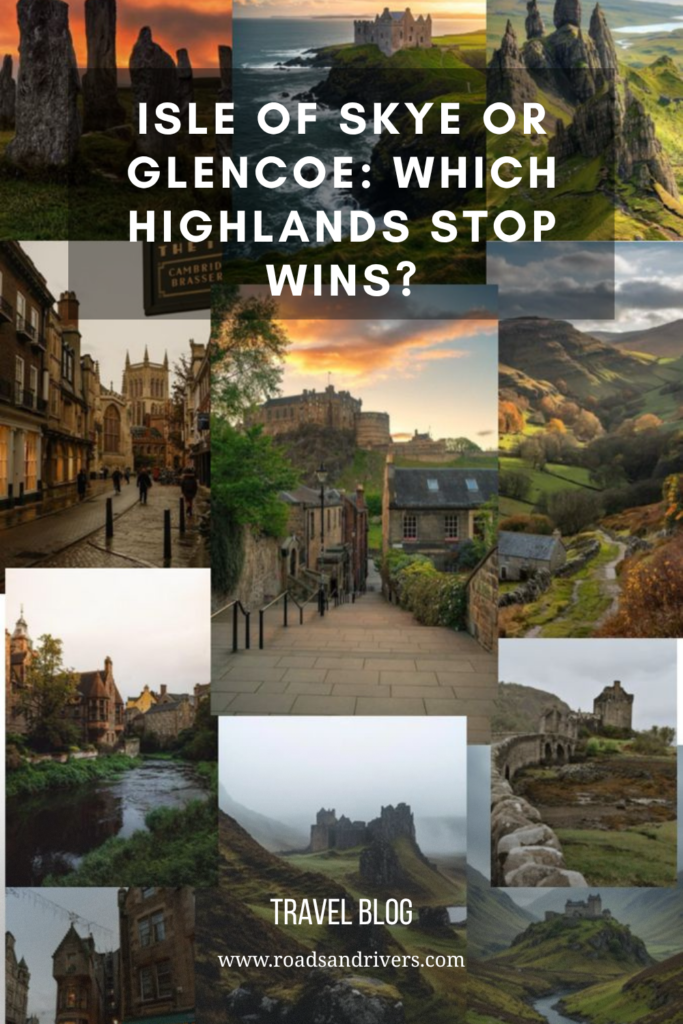
This is the question that dominates every Highlands planning conversation. Both are spectacular. Both are essential. But if you are short on time and can only give one of them a full day, here is how they compare.
Choose Glencoe if: you want the most dramatic valley scenery in Scotland, you enjoy hiking and do not mind moderate trails, you want fewer tourists (Glencoe gets less traffic than Skye), or you are visiting in winter when Skye’s roads can be difficult.
Choose the Isle of Skye if: you want the widest variety of landscapes in one place (sea cliffs, fairy-tale rock formations, waterfalls, fishing villages), you want the full Scottish island experience, or you are visiting in summer when the long daylight makes Skye’s scattered attractions more accessible.
The honest answer for most travellers is to do both. They are different enough in character that skipping either one means missing a significant part of what makes the Highlands special. Glencoe is the brooding valley. Skye is the otherworldly island. Together they give you the full range.
Pro tip: If you are doing both, Glencoe first and Skye second works better logistically and emotionally. Glencoe sets the tone. Skye delivers the variety. Ending on Skye means your final Highlands memories are of sea, cliff, and light.
The Castles, Lochs, and Glens Worth Stopping For
Scotland has over 3,000 castles and more than 30,000 freshwater lochs. You cannot see them all. These are the ones that justify pulling over.
Eilean Donan Castle
The one on every shortbread tin and postcard. It earns the cliché. The castle sits on a small island where three sea lochs meet, connected to the mainland by a stone bridge. Visit in the morning when the tour buses have not arrived or in the late afternoon when they have left. The castle interior is mildly interesting. The exterior, especially from the viewpoint across the water, is unforgettable.
Glencoe Valley
Not a castle but a glen that holds more atmosphere than most buildings. The Three Sisters (three massive ridges descending into the valley) are the centrepiece. The Massacre of Glencoe in 1692, when the Campbell clan killed 38 members of the MacDonald clan while being hosted as guests, gives the valley a weight that goes beyond scenery. Walking into it in the rain, with cloud covering the peaks, is one of the most powerful landscape experiences in Scotland.
Loch Ness
Worth a stop but not worth a full day. The loch itself is large (37 km long, up to 230 metres deep) and impressive in scale but visually less dramatic than the lochs further west. Urquhart Castle on the western shore is the best vantage point and the most worthwhile stop. Do not pay for a monster-hunting boat tour.
The Glenfinnan Viaduct
The 21-arch railway viaduct that became world-famous through a certain wizard film franchise. It is impressive as a piece of Victorian engineering regardless of film associations. The Jacobite steam train crosses it twice daily (heading west in the morning, returning in the afternoon). The viewpoint from the hill above takes 10 minutes to reach and gives you the classic angle. Get there 20 minutes before the train is due.
Highlands Photography: How to Capture the Mood

The Scottish Highlands are one of the most photogenic landscapes in Europe, but they resist the usual approach. The light is rarely bright. The colours are muted. The sky is almost always doing something dramatic but rarely something sunny. Photographing the Highlands well means embracing those conditions rather than fighting them.
Shoot in rain and mist. The moody, atmospheric images that define the Highlands aesthetic come from weather that most tourists try to avoid. Mist in the valleys, rain on the lochs, and low cloud on the peaks are not obstacles to photography. They are the photography. Bring a waterproof camera bag or a simple zip-lock bag for your phone.
Use the golden hours. Scotland’s low sun angle means golden hour lasts much longer than in southern Europe. In summer, the evening light can stretch from 7 PM to 10 PM. In autumn, the golden tones on the bracken and heather are extraordinary between 4 PM and 5 PM.
Include scale elements. The Highlands are vast and photographs that show only landscape can lose their sense of scale. A person standing in a glen, a single cottage below a mountain, or a car on a single-track road all provide the visual anchor that turns a landscape shot into something more compelling.
Expect to reshoot. The weather changes so quickly in the Highlands that the same viewpoint can look completely different within 30 minutes. If the light is flat when you arrive, wait. If it is raining, keep shooting. Some of the best Highlands photographs come from conditions that initially seemed hopeless.
If you enjoy dramatic landscape photography, the Lofoten Islands guide covers another northern European destination where moody weather creates extraordinary images.
When to Go and What the Weather Actually Does
The weather in the Scottish Highlands is unpredictable in every season. That is not a travel cliché; it is a literal meteorological fact. The Highlands sit at the meeting point of Atlantic weather systems and continental air, which means conditions can shift from sunshine to horizontal rain within an hour.
May-June is the best window for most travellers. The days are long (up to 18 hours of light), the midges (tiny biting insects) have not yet peaked, the wildflowers are out, and the roads are quieter than July and August. Temperatures range from 10-18°C.
July-August brings the warmest temperatures and the highest tourist numbers. It is also peak midge season. The midges are small, persistent, and appear in clouds near still water during calm evenings. They are not dangerous but they are deeply unpleasant. Bring midge repellent (Smidge brand is the local favourite) and a head net if you plan to hike.
September-October is when the Highlands turn gold and rust. The bracken changes colour, the heather fades, and the autumn light creates the richest tones of the year. Tourist numbers drop sharply after the August Bank Holiday. This is the photographer’s season.
November-March is cold, wet, dark, and spectacular. Snow on the peaks, frozen lochs, and 7-hour days create an atmosphere that is genuinely other-worldly. Accommodation is cheap and the Highlands are empty. But roads can be impassable, especially to Skye and the northwest. Winter Highlands travel requires confidence with winter driving and flexibility with plans.
Read more: Best Interrail Routes in Europe if you want to connect Edinburgh and the Highlands with a wider UK or European rail trip.
Practical Planning: Budget, Accommodation, and Getting Around
Budget
The Scottish Highlands are not a budget destination in the way Southeast Asia is, but they are reasonable by Western European standards. A mid-range daily budget of £80-120 per person covers accommodation, car fuel, food, and activities. Budget travellers can bring this down to £40-60 by camping, self-catering, and staying in hostels.
Car hire from Edinburgh starts at £25-40 per day for a small car. Fuel costs £1.40-1.55 per litre in 2026. Entry to most natural sites (glens, lochs, viewpoints) is free. Castle and museum entries range from £8-15 per person.
Accommodation
The Highlands accommodation landscape runs from wild camping (legal in Scotland under the right to roam) to country house hotels. In between, you have hostels (SYHA and independent), B&Bs (the classic Scottish option, often run by characters worth meeting), Airbnbs and holiday cottages, and small hotels.
Book ahead for July and August, especially on the Isle of Skye where accommodation fills up months in advance. Outside peak season, you can often find same-day availability.
Getting Around Without a Car
A car is the easiest way to see the Highlands but it is not the only way. The West Highland Line from Glasgow to Fort William and Mallaig is one of the most beautiful train journeys in the world. Citylink buses connect Edinburgh and Glasgow to Fort William, Portree (Skye), and Inverness. A combination of train, bus, and the occasional taxi can cover the main stops, though you will have less flexibility than with a car.
For anyone planning a wider European trip that includes Scotland, the backpacking Europe guide covers how to connect the UK with continental Europe efficiently. And for trekking essentials for any Highlands hiking you plan to do, the trekking essentials guide covers the gear that matters.
Key Takeaways
- The Scottish Highlands reward 5-7 days. Fewer than 5 means rushing through a landscape that was built for slow travel.
- Glencoe and the Isle of Skye are the two must-see stops. Do both if you can. If forced to choose, Glencoe is the emotional heart and Skye is the scenic variety.
- Single-track roads, unpredictable weather, and sparse infrastructure are part of the experience, not problems to solve. Embrace them.
- May-June and September-October are the best months. Summer is warmest but brings midges and crowds.
- The Highlands look best in moody weather. Rain, mist, and cloud are not obstacles to a great trip. They are the atmosphere.
The Scottish Highlands are one of those places that shift something inside you. Not because they are exotic or unfamiliar, but because they are so old and so quiet and so utterly themselves that standing in a glen in the rain feels less like tourism and more like remembering something you did not know you had forgotten.
Drive north. Take the single-track road. Pull over when the view stops you. That is the only itinerary that matters.
What is your favourite Highlands stop? Drop it in the comments. And if you are still in the planning phase, ask anything below.
FAQ
How many days do you need for the Scottish Highlands?
Five to seven days is the ideal range. Five days allows you to cover Glencoe, the Isle of Skye, and Inverness with comfortable driving days. Seven days gives you time for the northern Highlands, additional hikes, and flexibility for weather delays. Three-day trips are possible but involve long driving days and limited time at each stop.
Is it worth driving the Scottish Highlands yourself?
Yes, driving is the best way to experience the Highlands. The freedom to stop at viewpoints, take detours, and travel at your own pace is essential in a landscape where the journey is as important as the destination. Single-track roads require patience and attention but are safe at appropriate speeds. Rent the smallest car that meets your needs; narrow roads favour compact vehicles.
What is the best time to visit the Scottish Highlands?
May and June offer the best combination of long daylight, mild weather, and manageable tourist numbers. September and October bring autumn colours and dramatic light. July and August are warmest but bring midges and higher prices. Winter is cold and dark but offers snow-capped peaks and complete solitude.
Can you visit the Highlands without a car?
Yes, using a combination of the West Highland Line train, Citylink buses, and local services. The train from Glasgow to Fort William and Mallaig is a highlight in itself. Buses reach Skye, Glencoe, and Inverness. However, you will have less flexibility than with a car and some remote viewpoints and trailheads will be inaccessible. Guided day tours from Edinburgh and Inverness are another option for specific areas.
What should you pack for the Scottish Highlands?
Waterproof layers are essential regardless of season. The Highlands can produce rain, wind, and sunshine within the same hour. A waterproof jacket, waterproof hiking boots or shoes, warm mid-layers (fleece or merino), and a hat are the minimum. In summer, add midge repellent and a head net. In winter, add thermal base layers and gloves. Dress in layers and assume you will get wet at some point.