
I spent 10 days in Bali and the total came to $847 USD. That included accommodation, food, transport, activities, a Nusa Penida day trip, two temple visits, a cooking class, and more smoothie bowls than I should probably admit to. No hostels. No skipping meals. No pretending I was having a good time while secretly panicking about the bill.
That number surprises people. Bali travel has a reputation for being either a luxury wellness retreat or a backpacker hostel crawl, with nothing in between. But the reality is that Bali is one of the most flexible budget destinations in Southeast Asia. You can spend $30 a day or $300 a day and have an excellent trip either way. The difference is not luck. It is knowing which choices actually matter and which ones are just expensive versions of the same experience.
This guide breaks down the real costs, the real mistakes, and the real strategies that make a budget Bali trip feel like anything but a compromise.
Table of Contents
- Can You Really Do Bali Without Blowing Your Savings?
- Bali on a Budget: Real Costs for 10 Days
- 7 Money-Saving Moves That Actually Work
- 5 Bali Budget Mistakes Tourists Always Make
- Where to Stay: Area-by-Area Budget Breakdown
- Rice Terraces, Temples, and Beaches: What to Do on a Budget
- How to Eat Well in Bali for Under $10 a Day
- Getting Around Bali Without Overpaying
- FAQ
Can You Really Do Bali Without Blowing Your Savings?
Yes. The short answer is that Bali is genuinely affordable if you make a handful of smart decisions early in your planning. The long answer is that Bali has two economies running side by side: the tourist economy and the local economy. They serve the same island but at wildly different price points.
A nasi goreng (fried rice) at a beachfront restaurant in Seminyak costs 85,000-120,000 IDR ($5.50-$7.50). The same dish at a warung (local eatery) 200 metres from the beach costs 15,000-25,000 IDR ($1-$1.60). Both are good. The warung version is often better because the cook has been making it for 20 years.
This pattern repeats across every spending category. A private driver booked through your hotel costs $60-80 a day. The same driver booked directly through a local contact or Grab app costs $35-45. A yoga class at a branded wellness studio in Ubud costs $15-20. A drop-in class at a smaller shala on a side street costs $5-8.
The trick is not deprivation. It is knowing where the tourist markup sits and stepping around it. You do not have to give up the infinity pool breakfast or the cliff-top sunset. You just have to be strategic about which version you pay for.
Pro tip: The Indonesian Rupiah makes everything feel confusing at first. A quick hack: drop three zeros and divide by 16 to get approximate USD. So 250,000 IDR is roughly $15.60. After two days this becomes automatic.
Bali on a Budget: Real Costs for 10 Days
Here is an honest breakdown of what 10 days in Bali actually costs at three different budget levels. These are 2026 prices based on real spending, not estimates from five years ago.
Budget Traveller ($25-40 USD/day)
| Category | Daily Cost | 10-Day Total |
|---|---|---|
| Accommodation (guesthouse/homestay) | $8-15 | $80-150 |
| Food (warungs + occasional cafe) | $6-10 | $60-100 |
| Transport (scooter rental) | $4-5 | $40-50 |
| Activities | $5-8 | $50-80 |
| Total | $23-38 | $230-380 |
Mid-Range Traveller ($50-80 USD/day)
| Category | Daily Cost | 10-Day Total |
|---|---|---|
| Accommodation (boutique hotel/nice Airbnb) | $25-40 | $250-400 |
| Food (mix of warungs, cafes, restaurants) | $12-20 | $120-200 |
| Transport (scooter + occasional driver) | $5-10 | $50-100 |
| Activities | $10-15 | $100-150 |
| Total | $52-85 | $520-850 |
Comfortable Traveller ($100-150 USD/day)
| Category | Daily Cost | 10-Day Total |
|---|---|---|
| Accommodation (villa with pool) | $50-80 | $500-800 |
| Food (restaurants + beach clubs) | $25-40 | $250-400 |
| Transport (private driver) | $10-15 | $100-150 |
| Activities | $15-25 | $150-250 |
| Total | $100-160 | $1,000-1,600 |
These numbers exclude flights. Return flights to Bali from Europe typically run $500-900 and from Australia $200-400, depending on season and how far ahead you book.
Read more: The Ultimate Bali Packing List covers everything you need to bring (and what to leave at home) so you are not buying overpriced replacements at tourist shops.
7 Money-Saving Moves That Actually Work
Not all budget advice is created equal. Some tips save you 5,000 IDR. These seven save you hundreds of dollars over a 10-day trip.
1. Rent a scooter, not a driver. A scooter costs 60,000-80,000 IDR ($4-5) per day. A private driver costs 600,000-900,000 IDR ($38-56) per day. If you are comfortable on two wheels, this is the single biggest money saver. Petrol is cheap (about 10,000 IDR per litre) and Bali is small enough that you can cross most of the island in 90 minutes.
2. Stay in homestays, not hotels. Balinese homestays (often run by families with a few rooms attached to their home) cost 100,000-250,000 IDR ($6-16) per night and usually include breakfast. Many have gardens, pools, and a level of warmth that chain hotels cannot replicate. Book directly when possible rather than through platforms that charge commission.
3. Eat at warungs for at least two meals a day. A full meal at a warung (nasi campur, nasi goreng, mie goreng, or similar) costs 15,000-35,000 IDR ($1-2.20). Do the maths: if you eat two warung meals and one cafe meal per day, your daily food spend drops to $6-12.
4. Book Nusa Penida as a day trip, not through a tour company. Tour companies charge $40-70 for a Nusa Penida day trip that includes a fast boat, driver, and lunch. You can book the same fast boat yourself (200,000-350,000 IDR return), hire a local driver on the island (400,000 IDR for a full day), and eat at a warung. Total: roughly $30-35 for a better, less rushed experience.
5. Visit temples independently. Temple entrance fees are cheap (10,000-50,000 IDR) but guided tours to temples charge $30-60 per person for transport and a guide. Most temples are easily reachable by scooter and do not require a guide to enjoy. Tirta Empul, Tanah Lot, and Uluwatu are all straightforward to visit on your own.
6. Use Grab instead of negotiating taxis. The Grab app (Southeast Asia’s equivalent of Uber) gives you a fixed price before the ride starts. This avoids the negotiation dance with taxi and ojek drivers who frequently charge tourists 2-3 times the going rate. Grab bikes are especially cheap: 10,000-25,000 IDR for most short trips.
7. Time your trip for shoulder season. April, May, September, and October offer the best combination of good weather and lower prices. Accommodation drops 20-40% compared to peak season (July-August and Christmas/New Year). The weather in shoulder months is nearly as good as peak season.
5 Bali Budget Mistakes Tourists Always Make
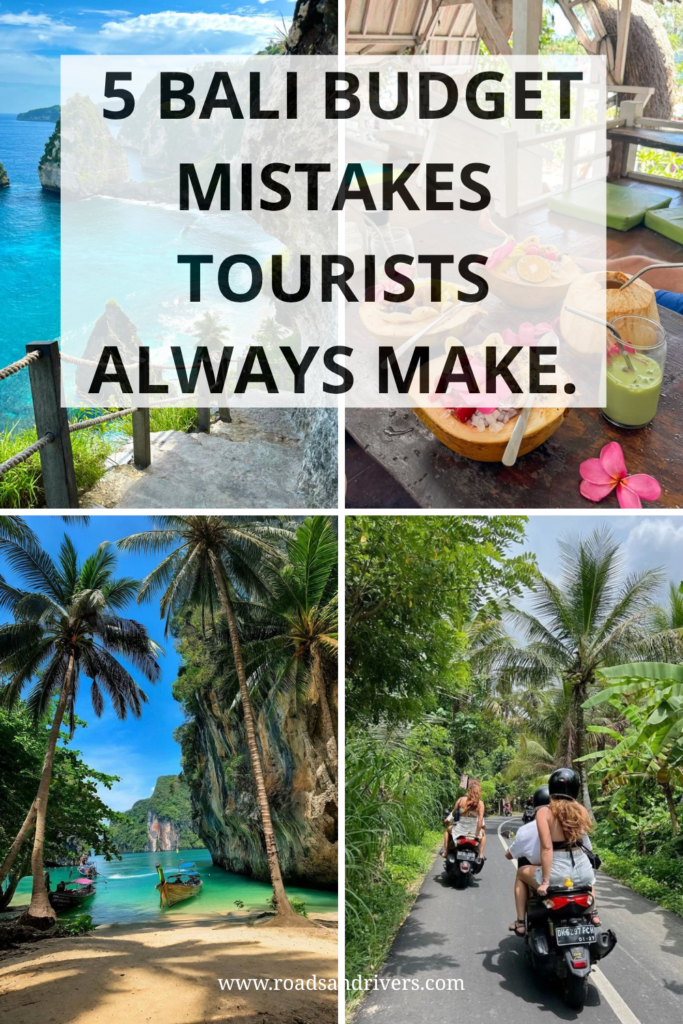
These are the errors that turn a cheap Bali trip into an expensive one. Every one of them is avoidable.
1. Staying in Seminyak or Kuta for the whole trip. These are the most expensive areas in Bali for food, drinks, and accommodation. They are worth a night or two for the beach clubs and nightlife, but basing your entire trip here inflates every cost category. Ubud, Canggu (away from the main strip), and Amed are significantly cheaper.
2. Exchanging money at the airport. The airport exchange rate is the worst on the island. Use an ATM instead (BCA and Mandiri ATMs have the lowest fees) and withdraw larger amounts (2,500,000-3,000,000 IDR) to minimise per-transaction charges. Better yet, use a Wise or Revolut card for purchases and cash withdrawals.
3. Paying tourist tax without realising it. Many restaurants, hotels, and activity providers in tourist areas add a 15-21% service and tax charge that is not included in the listed price. Check the menu or quote for “++” (which means plus service charge plus tax). At warungs and local businesses, the price is the price.
4. Booking everything through your hotel. Hotels mark up tours, drivers, cooking classes, and transfers by 30-50%. Book directly with local providers, use Google Maps to find operators, or ask your homestay host for recommendations instead of the hotel concierge.
5. Over-planning activities. Some of the best experiences in Bali are free or nearly free: watching sunrise from a rice terrace, swimming at a secluded beach, walking through a village during a ceremony, or sitting in a warung watching the world pass. Tourists who fill every hour with paid activities spend more and often enjoy less.
Where to Stay: Area-by-Area Budget Breakdown
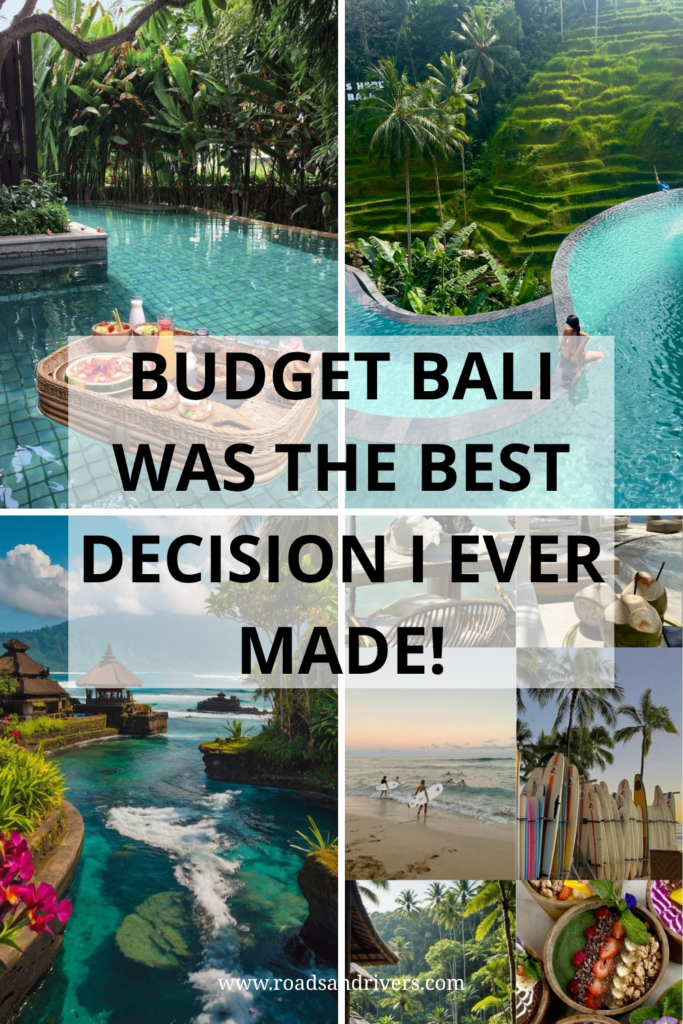
Bali is not one place. Each area has a different vibe, a different price point, and a different type of traveller it attracts.
Ubud: The Culture and Wellness Base
Ubud is the spiritual and cultural centre of Bali. Rice terraces, monkey forest, temples, yoga studios, and some of the best warungs on the island. It is also the most affordable area for accommodation. Homestays with breakfast start at 100,000 IDR ($6) and boutique guesthouses with pools start at 300,000 IDR ($19). The Bali aesthetic of tropical infinity pools overlooking jungle valleys exists here at surprisingly accessible prices.
Best for: solo travellers, wellness seekers, culture lovers, budget travellers. Ubud is the default recommendation for first-timers who want to experience Bali beyond the beach.
Canggu: The Digital Nomad and Surf Hub
Canggu has become the most popular area for young travellers and remote workers. It has excellent cafes, a strong surf scene, and a social energy that Ubud lacks. Prices are moderate: guesthouses from 200,000 IDR ($13), co-working spaces from 100,000 IDR ($6) per day. The main strip around Batu Bolong can feel oversaturated with tourists, but move a few streets inland and prices drop noticeably.
Best for: surfers, digital nomads, social travellers, anyone who wants nightlife without Kuta’s chaos.
Uluwatu and the Bukit Peninsula: Cliffs and Surf
The southern tip of Bali has dramatic cliff-top scenery, world-class surf breaks, and the famous Uluwatu Temple. Accommodation ranges from basic surfer lodges (150,000 IDR) to cliff-edge villas. It feels more remote than Canggu or Seminyak, which is part of the appeal.
Best for: surfers, couples, travellers who want scenery without the crowd density of central Bali.
Amed and East Bali: The Quiet Side
If you want the Bali that existed before Instagram, head east. Amed is a strip of fishing villages along the northeast coast with excellent snorkelling, black sand beaches, and accommodation so cheap it barely registers: beachfront bungalows from 120,000 IDR ($7.50). The pace is slow and the tourist infrastructure is minimal, which is exactly the point.
Best for: snorkellers, divers, travellers who want quiet, anyone on a tight budget.
If you are considering a broader Southeast Asia trip, the guide to backpacking Asia on a budget covers how Bali fits into a larger regional itinerary and which countries pair well together.
Rice Terraces, Temples, and Beaches: What to Do on a Budget

The best things to do in Bali fall into three categories: natural landscapes, cultural sites, and water activities. Almost all of them are affordable.
Rice Terraces
The Tegallalang Rice Terrace near Ubud is the most photographed but also the most crowded and the most aggressive with photo fees (locals at each viewing platform ask for 10,000-20,000 IDR donations). The Jatiluwih Rice Terraces, a UNESCO World Heritage Site further north, are larger, less crowded, and more rewarding. Entrance is 40,000 IDR and you can walk the trails for hours with barely another tourist in sight.
Temples
Bali has over 20,000 temples and the entry fees are among the cheapest activities on the island. Tanah Lot (60,000 IDR) is the most iconic, a sea temple perched on a rock formation just offshore. Uluwatu Temple (50,000 IDR) sits on a cliff 70 metres above the ocean and hosts a nightly Kecak fire dance at sunset (an additional 100,000 IDR and worth it). Tirta Empul (50,000 IDR) is a holy spring temple where you can participate in the purification ritual alongside Balinese worshippers.
Beaches
Most beaches in Bali are free. Padang Padang, Dreamland, and Bingin on the Bukit Peninsula are all stunning and cost nothing beyond the scooter fuel to get there. Nusa Penida (reachable by a 30-minute fast boat from Sanur) has Kelingking Beach and Broken Beach, two of the most dramatic coastal views in Southeast Asia.
Waterfalls
Bali has dozens of waterfalls within easy reach. Tegenungan (20,000 IDR) is the closest to Ubud and the most popular. Sekumpul (30,000 IDR) in north Bali is widely considered the most beautiful on the island but requires a steep hike down (and back up). Tibumana (20,000 IDR) is the best combination of easy access and low crowds.
Read more: How To Backpack the Philippines on $25 a Day if you want to extend your Southeast Asia trip to another island destination with similar budget potential.
How to Eat Well in Bali for Under $10 a Day
Eating well on a budget in Bali is not a compromise. The local food is exceptional and the prices at warungs and local markets are so low that eating cheaply actually means eating more authentically.
Breakfast: Most homestays include breakfast. If not, a smoothie bowl at a local cafe costs 35,000-55,000 IDR ($2.20-3.50), or nasi goreng at a warung for 15,000-20,000 IDR ($1-1.25).
Lunch: Nasi campur (rice with assorted sides) is the Balinese lunch staple. At a warung, a full plate with rice, vegetables, sambal, a protein, and sometimes a small soup costs 20,000-35,000 IDR ($1.25-2.20). This is the meal that makes budget Bali possible. You eat this every day and you never get bored because the sides change daily.
Dinner: A step up: a seafood meal at a Jimbaran beach warung costs 80,000-150,000 IDR ($5-9.50) for grilled fish, rice, sambal, and vegetables. In Ubud, the best warungs along Jalan Goutama serve complete dinners for 25,000-40,000 IDR. Even treating yourself to a nicer restaurant in Canggu or Seminyak rarely exceeds $15-20 per person for a full meal.
Snacks and drinks: Fresh coconuts from roadside stalls (10,000-15,000 IDR), fresh fruit from markets (bananas, mangoes, dragon fruit at 5,000-15,000 IDR per portion), and Bali’s famously good coffee (10,000-15,000 IDR at a warung, 35,000-55,000 IDR at a specialty cafe).
A realistic daily food spend eating well: 60,000-120,000 IDR ($3.75-7.50) if you stick mostly to warungs, or 120,000-200,000 IDR ($7.50-12.50) if you mix in one cafe or restaurant meal.
Getting Around Bali Without Overpaying
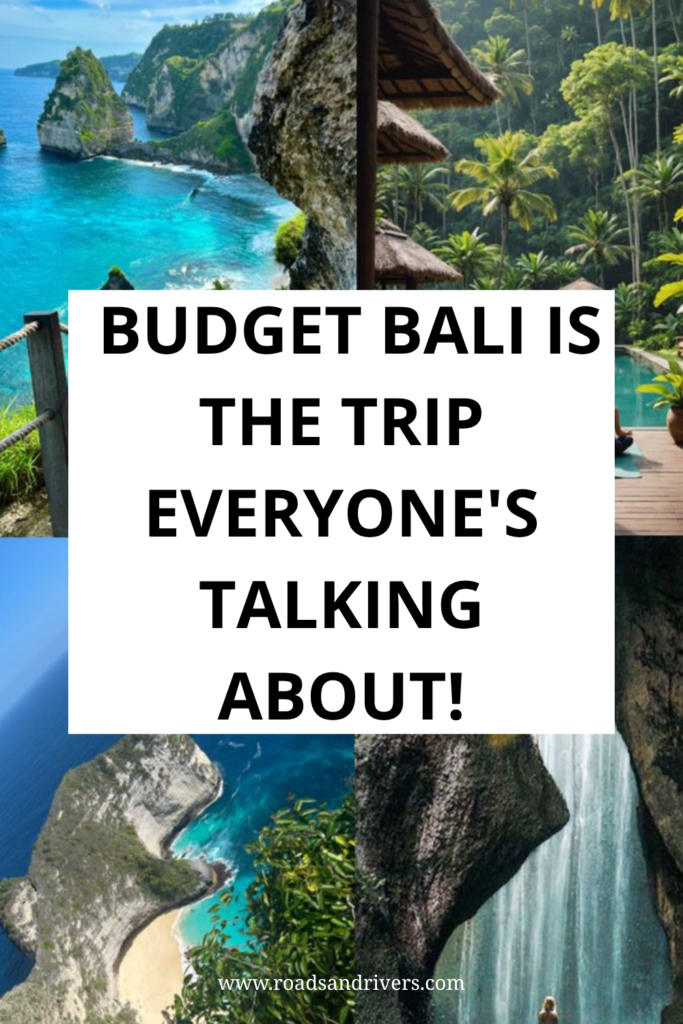
Transport is one of the biggest budget leaks in Bali. The island has no public transport network to speak of, which means every trip outside walking distance requires a decision.
Scooter rental is the cheapest and most flexible option. Daily rates are 60,000-80,000 IDR ($4-5) and weekly rates drop to 50,000-60,000 IDR per day. You need an international driving permit (IDP) with a motorcycle endorsement. Bali traffic is chaotic but manageable if you drive slowly and defensively. Helmets are legally required and provided with every rental.
Grab (ride-hailing app) is the next best option. Grab bikes cost 10,000-25,000 IDR for short trips and Grab cars cost 30,000-80,000 IDR for medium distances. Note that Grab is banned or restricted in some tourist areas (Ubud centre, parts of Seminyak) due to local taxi driver protests. Walk a few hundred metres outside the restricted zone and the app works normally.
Private driver for a full day (8-10 hours) costs 500,000-700,000 IDR ($31-44) booked directly, or 800,000-1,200,000 IDR ($50-75) through a hotel. A private driver makes sense for temple-hopping days when you want to cover multiple locations. Split the cost with another traveller if you can.
Fast boats to the islands (Nusa Penida, Nusa Lembongan, Gili Islands) range from 150,000-400,000 IDR ($9-25) one way depending on the route and operator. Book through your accommodation or directly at the harbour for the best prices. Avoid the touts on Sanur beach who charge triple.
Pro tip: Never agree to a transport price without checking Grab first, even if you plan to use a local driver. The Grab price gives you a fair benchmark and prevents overpaying.
If you are heading to another Southeast Asian country after Bali, the best islands in Thailand guide helps you pick between Koh Phangan, Koh Lanta, and the other options that pair well with a Bali trip. And for anyone considering India after Indonesia, backpacking India on $20 a day covers a destination that is even cheaper than Bali but requires more planning.
Key Takeaways
- Bali on a budget is entirely realistic. A 10-day trip at the mid-range level costs $520-850 USD excluding flights, and the budget version comes in under $400.
- The biggest savings come from renting a scooter, eating at warungs, staying in homestays, and booking activities directly rather than through hotels.
- Ubud and Amed are the cheapest bases. Canggu is mid-range. Seminyak and Kuta are the most expensive and the least representative of what makes Bali special.
- Local food at warungs is not just cheaper but often better than the tourist-facing alternatives. A full day of eating at warungs costs $4-8.
- Shoulder season (April-May, September-October) gives you nearly the same weather as peak season at 20-40% lower prices.
Budget Bali is not about settling for less. It is about spending your money on the things that actually define the experience: the temple ceremonies, the rice terrace sunrise, the warung dinner where the cook brings you a dish you did not order because she thought you should try it, the scooter ride through a village as the evening light turns the palms gold.
Those are the moments you remember. And none of them cost more than a few dollars.
Book the flight. Start in Ubud. Let the island work its magic.
Have you done Bali on a budget? Drop your best money-saving tip in the comments. What was your daily spend?
FAQ
How much does a 10-day trip to Bali cost on a budget?
A budget 10-day trip to Bali costs roughly $230-380 USD (excluding flights). This assumes homestay accommodation, warung meals, scooter rental for transport, and self-guided activities. A mid-range trip with boutique hotels, a mix of warungs and restaurants, and some guided activities costs $520-850 USD for the same period.
Is Bali actually cheap in 2026?
Bali remains one of the most affordable destinations in Southeast Asia. Local food, transport, and accommodation are very cheap by Western standards. Where costs add up is in the tourist-facing economy: beach clubs, branded wellness studios, and upscale restaurants in Seminyak and Canggu. Sticking to warungs, homestays, and scooters keeps daily spending under $40 USD comfortably.
What is the cheapest area to stay in Bali?
Amed on the east coast and Ubud in the central highlands are the cheapest areas for accommodation. Beachfront bungalows in Amed start at $7-8 per night. Homestays in Ubud with breakfast included start at $6-10 per night. Both areas also have the cheapest food prices on the island.
Is Bali safe for solo travellers?
Bali is one of the safest destinations in Southeast Asia for solo travellers. The Balinese are welcoming and the tourist infrastructure is well established. Standard precautions apply: be careful on scooters (the roads are the biggest safety risk), do not leave valuables unattended on the beach, and use Grab rather than unmarked taxis at night. Solo female travellers report feeling safe in all main tourist areas.
What are the best free things to do in Bali?
Beaches (Padang Padang, Dreamland, Bingin), rice terrace walks (Jatiluwih and smaller terraces near Ubud), watching village ceremonies and temple processions, sunrise from any east-facing viewpoint, and exploring village markets are all free. Many of Bali’s most memorable experiences cost nothing at all.