Vietnam is a country shaped like the letter S, stretched 1,650 km along the eastern edge of Southeast Asia, and that shape tells you everything about how to travel it. You start at one end, you work your way to the other, and every few hundred kilometres the food changes, the accent shifts, the landscape transforms, and you feel like you have crossed into a different country entirely. The north is mountains and mist and pho. The centre is lanterns and imperial ruins and the best banh mi on earth. The south is heat and chaos and noodle soup at 6 AM on a plastic stool in Saigon.
This Vietnam travel guide is structured the way the country is shaped: top to bottom. Each section covers one region as a self-contained mini-guide, so you can read the whole thing for a 2-3 week route or drop into the section that covers where you are actually going.
How This Guide Works
Instead of a single itinerary or a list of tips, this guide treats Vietnam as five distinct regions that you string together like beads on a wire. Each region gets its own food highlight, must-see experience, budget note, and honest assessment of how many days it deserves. Pick your entry point, decide your direction, and build your route.

Region 1: Hanoi and the Far North
The City: Hanoi (2-3 days)
Hanoi is sensory overload in the best possible way. The Old Quarter is a maze of 36 streets, each historically named for the trade it sold (Silk Street, Paper Street, Silver Street), and it is still the most atmospheric urban walking experience in Southeast Asia. Motorbikes weave around you. Street vendors carry bamboo poles across their shoulders with baskets of fruit hanging from each end. The smell of grilled pork and fresh herbs comes from every other doorway.
What to eat first: Pho bo (beef pho) at a streetside stall in the Old Quarter. Hanoi pho is lighter and cleaner than the southern version: clear broth, thin rice noodles, and herbs you add yourself. A bowl costs 35,000-50,000 VND ($1.40-2). Eat it for breakfast like the locals do.
What most tourists miss: Bun cha, the smoky grilled pork and noodle dish served with herbs and a dipping broth. It is Hanoi’s signature dish (more so than pho) and it is best eaten at a small stall where the pork is grilled over charcoal on the pavement outside. 40,000-60,000 VND ($1.60-2.40).
The essential experience: Walk the Old Quarter at dawn before the tourist shops open, when the city belongs to the locals doing tai chi by the lake, buying vegetables at the market, and drinking ca phe trung (egg coffee) at tiny tables on the pavement.
The Mountains: Sapa and Ha Giang (3-5 days)
The far north is where Vietnam becomes vertical. Rice terraces carved into mountain slopes, minority villages where traditional textiles are still woven by hand, and roads that twist through cloud-level passes.
Sapa is the most accessible mountain town, reachable by overnight train or bus from Hanoi. The Muong Hoa Valley rice terraces are the draw. They are most photogenic in September-October (harvest season, golden paddies) and May-June (planting season, flooded terraces reflecting the sky).
Ha Giang is the adventure option: a 4-day motorbike loop through the most dramatic mountain scenery in Vietnam. The road passes through limestone karst valleys, ethnic minority markets, and landscapes that have barely changed in centuries. It is not for cautious travellers but it is, by most accounts, the single most memorable experience in the country.
Read more: Ultimate Guide on Backpacking Asia in a Budget Friendly Way for how Vietnam fits into a broader Southeast Asia circuit.
Region 2: Ha Long Bay and Ninh Binh
Ha Long Bay (1-2 days)
The limestone karst islands rising from emerald water are the most iconic image of Vietnam and they live up to the photos. The bay contains roughly 1,600 islands and islets, many of them hollow with caves and hidden lagoons.
The budget approach: book a 2-day/1-night cruise from Hanoi. Prices range from $80-150 for a budget junk boat to $200-400 for mid-range. The cheapest cruises are fine for the scenery but often have crowded itineraries and rushed schedules. Mid-range cruises give you more time on the water and better food.
The alternative nobody talks about: Lan Ha Bay, adjacent to Ha Long Bay but less visited, offers the same karst scenery with a fraction of the tourist boats. Cruises depart from Cat Ba Island and are typically 20-30% cheaper than Ha Long equivalents.
Ninh Binh (1-2 days)
Often called “Ha Long Bay on land,” Ninh Binh is a limestone karst landscape with rivers winding through rice paddies and temples built into cliff faces. Tam Coc (boat ride through caves), Trang An (longer boat ride through a wider karst landscape), and Mua Cave (steep climb, panoramic view) are the three main experiences.
Ninh Binh is a 2-hour bus ride from Hanoi and works well as a day trip or overnight. It is significantly cheaper and less crowded than Ha Long Bay and arguably just as beautiful.
Region 3: Central Vietnam — Hue, Da Nang, and Hoi An
Central Vietnam is where the trip pivots. The food changes (the centre is famous for spicy, complex dishes), the architecture shifts from Chinese-influenced to Cham and French colonial, and the coastline opens up with long beaches and warm water.
Hue (1-2 days)
The former imperial capital. The Citadel (Imperial City) is a walled complex modelled on Beijing’s Forbidden City, partially destroyed during the Vietnam War and now partially restored. It is worth half a day. The royal tombs outside the city (Khai Dinh and Tu Duc are the most impressive) add another half day.
What to eat: Bun bo Hue, a spicy beef and pork noodle soup that is the finest noodle dish in Vietnam (a bold claim in a country of exceptional noodle soups, but widely agreed upon). A bowl costs 30,000-40,000 VND ($1.20-1.60).
Hoi An or Da Nang: Which Vietnam Stop Wins?

This is the central Vietnam question that every traveller faces. They are only 30 km apart but they serve completely different purposes.
Choose Hoi An if: you want the lantern-lit old town, the tailor shops, the riverside restaurant scene, the cooking classes, and the Vietnam aesthetic that fills Pinterest boards. Hoi An Ancient Town is a UNESCO World Heritage Site and it is extraordinarily photogenic, especially at night when the lanterns are lit and the Thu Bon River reflects them.
Choose Da Nang if: you want beaches, the Golden Bridge (Ba Na Hills), a more modern city experience, and access to both Hoi An (30-minute drive) and Hue (2-hour drive) as day trips.
The honest answer: Stay in Hoi An and day-trip to Da Nang. Hoi An is the emotional centre of central Vietnam and the place most travellers remember longest. Three nights is the minimum. The An Bang Beach area is a 10-minute bike ride from the old town and gives you beach time without the Da Nang hotel strip.
Pro tip: Rent a bicycle in Hoi An. The old town is car-free during certain hours and the countryside surrounding it (rice paddies, water buffalo, vegetable gardens) is flat and beautiful for cycling.
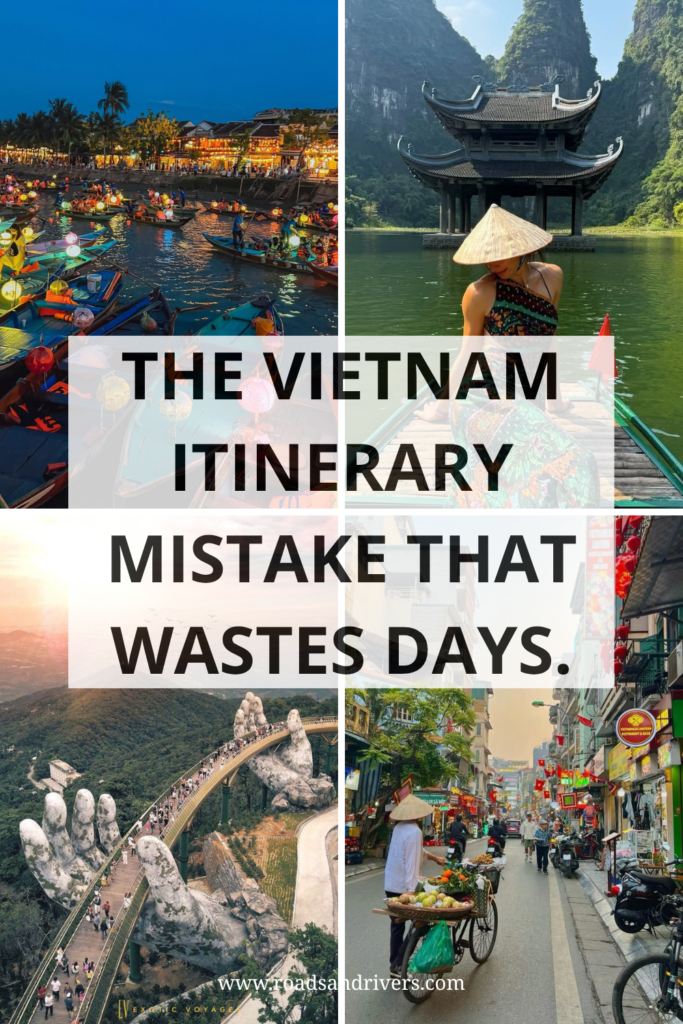
The Vietnam Itinerary Mistake That Wastes Days
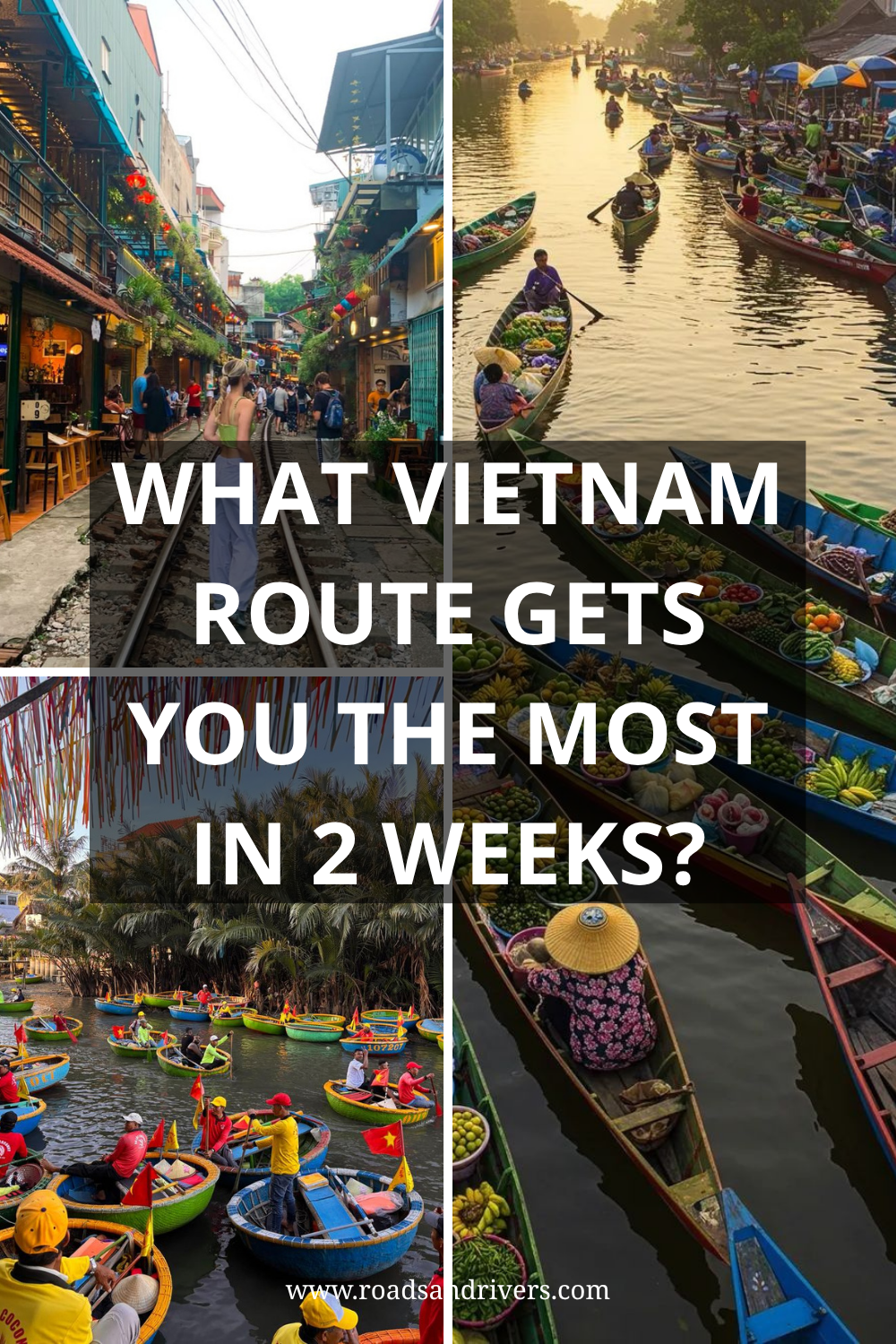
The single biggest mistake first-timers make in Vietnam is trying to see the entire country in two weeks. Vietnam is long. The distance from Hanoi to Ho Chi Minh City is roughly equivalent to London to Barcelona. Trying to cover everything means spending half your trip on buses, trains, and domestic flights instead of actually experiencing the places you came to see.
The better approach: pick one half of the country and do it properly, or take three weeks and do the full north-to-south route with enough breathing room.
2 weeks, north focus: Hanoi (3 days) → Sapa or Ha Giang (3-4 days) → Ha Long Bay (2 days) → Ninh Binh (1 day) → fly to Hoi An (3 days). Skip Ho Chi Minh City.
2 weeks, south focus: Fly into Da Nang → Hoi An (3 days) → Hue day trip → fly to Ho Chi Minh City (3 days) → Mekong Delta (2 days) → Phu Quoc (3-4 days).
3 weeks, full route: Hanoi (2-3 days) → Ha Long or Ninh Binh (2 days) → fly to Hue (1-2 days) → Hoi An (3 days) → fly to Ho Chi Minh City (2-3 days) → Mekong Delta (1-2 days) → Phu Quoc (3 days).
Domestic flights between Hanoi, Da Nang, and Ho Chi Minh City cost $30-60 one way on VietJet or Bamboo Airways and save 15-20 hours of overland travel. Use them.
Read more: How To Backpack the Philippines on $25 a Day if you are continuing from Vietnam to another Southeast Asian island destination.
Region 4: Ho Chi Minh City and the South
Ho Chi Minh City / Saigon (2-3 days)
Saigon (locals still use the old name) is everything Hanoi is not. It is flat, hot, modern, sprawling, and moves at a speed that makes Hanoi’s chaos feel quaint. The motorbike traffic is the densest in Southeast Asia and crossing the street for the first time is a genuine rite of passage.
What to eat: Everything, constantly. Saigon is the street food capital of Vietnam. Banh mi (the Vietnamese baguette sandwich, best at street carts for 20,000-30,000 VND/$0.80-1.20), com tam (broken rice with grilled pork, 35,000-50,000 VND), and pho (the southern version is sweeter and heavier than Hanoi’s, with more herbs and bean sprouts).
The neighbourhoods that matter: District 1 for the main sights (War Remnants Museum, Notre-Dame Cathedral, Ben Thanh Market). District 3 for the best local food streets. District 4 for the most authentic street food without any tourist markup. Binh Thanh for the modern cafe scene.
The Mekong Delta (1-2 days)
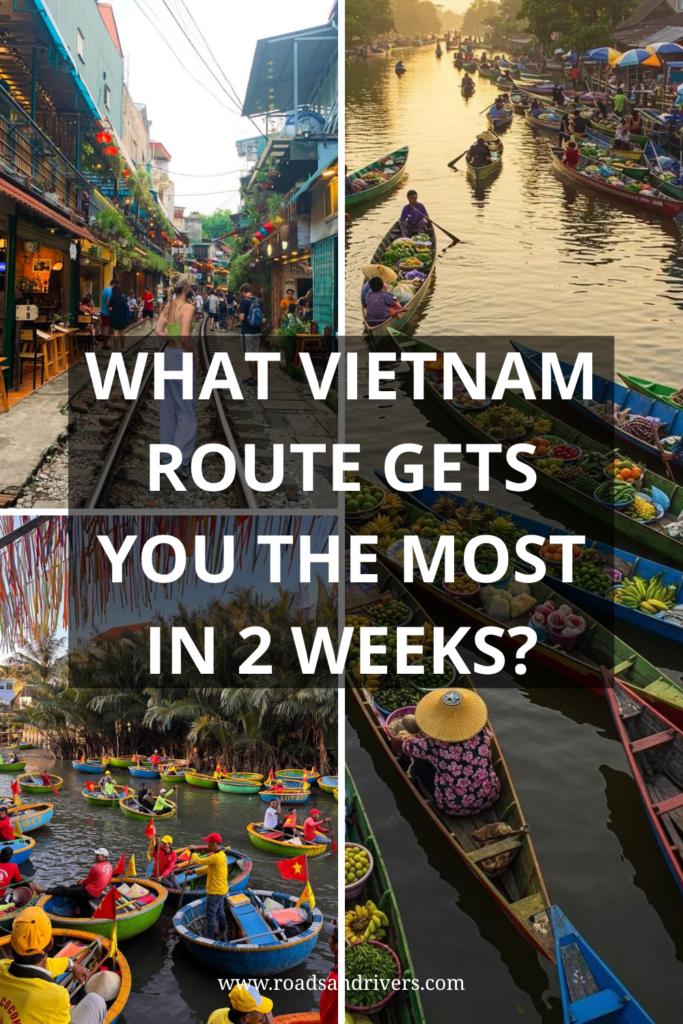
A 2-hour drive from Saigon takes you into the Mekong Delta, where life happens on water. Floating markets (Cai Rang is the largest, Phong Dien is the least touristy), coconut candy workshops, and boat rides through narrow palm-lined canals give you a Vietnam that looks nothing like the cities.
The Mekong works as a day trip from Saigon or an overnight. The overnight version, staying in a homestay in Can Tho, gives you access to the early morning floating market when the light is golden and the boats are loaded with fruit and vegetables.

Region 5: Islands and Beaches — Phu Quoc and Beyond
Vietnam has a coastline of over 3,400 km but the beach infrastructure has only recently caught up to the scenery. Phu Quoc, off the southwestern coast near the Cambodian border, is the standout island destination.
Phu Quoc (3-4 days)
A tropical island with white sand beaches on the west coast, a national park covering half the island, a night market with some of the best seafood in Vietnam, and a developing but not yet overdeveloped tourism scene. Long Beach and Sao Beach are the main options. The northern part of the island is quieter and cheaper.
Budget note: Phu Quoc is the most expensive destination in Vietnam outside of resort areas. Budget travellers can still manage on $30-40 per day with guesthouse accommodation and market food, but it is a step up from the mainland.
Other beach options: Quy Nhon (central coast, less developed, excellent seafood), Mui Ne (windsurfing and sand dunes), and Con Dao (remote former prison island turned national park, limited accommodation, extraordinary diving).
Read more: Best Islands in Thailand: How To Pick the Right One if you are comparing Vietnamese islands with Thai ones for the beach portion of your trip.

What Vietnam Actually Costs in 2026
Vietnam remains one of the cheapest countries in Asia for travellers. Here are the real numbers.
Budget traveller ($20-35/day): Hostel dorms or basic guesthouses ($5-10/night), street food for all meals ($5-8/day), local buses and trains ($2-10 per journey), free or cheap sights. This is the daily budget that makes Vietnam one of the best backpacking destinations in the world.
Mid-range traveller ($50-80/day): Boutique hotel or nice guesthouse ($20-40/night), mix of street food and restaurants ($10-20/day), domestic flights for long distances ($30-60), guided tours for select activities.
Comfortable traveller ($100-150/day): Resort or high-end hotel ($50-100/night), restaurants for most meals ($25-40/day), private transport and guides, premium experiences (luxury Ha Long Bay cruise, private cooking class).
The food math that makes Vietnam special: Three full meals of street food in Vietnam cost $3-5 total. That is less than a single coffee in many Western countries. This means you can eat extraordinarily well on any budget, which is something almost no other country offers at this quality level.
Pro tip: Grab (ride-hailing app) works across all major Vietnamese cities and is the safest, most reliable way to get around. A Grab motorbike across central Saigon costs 15,000-25,000 VND ($0.60-1). A Grab car costs 40,000-80,000 VND ($1.60-3.20).
Read more: Backpacking India on a Budget: How Far Can $20 a Day Go? for another ultra-affordable Asian destination that pairs well with Vietnam on a longer trip. And for planning a broader Asia route, the Singapore budget guide covers a common stopover on the way to or from Vietnam.
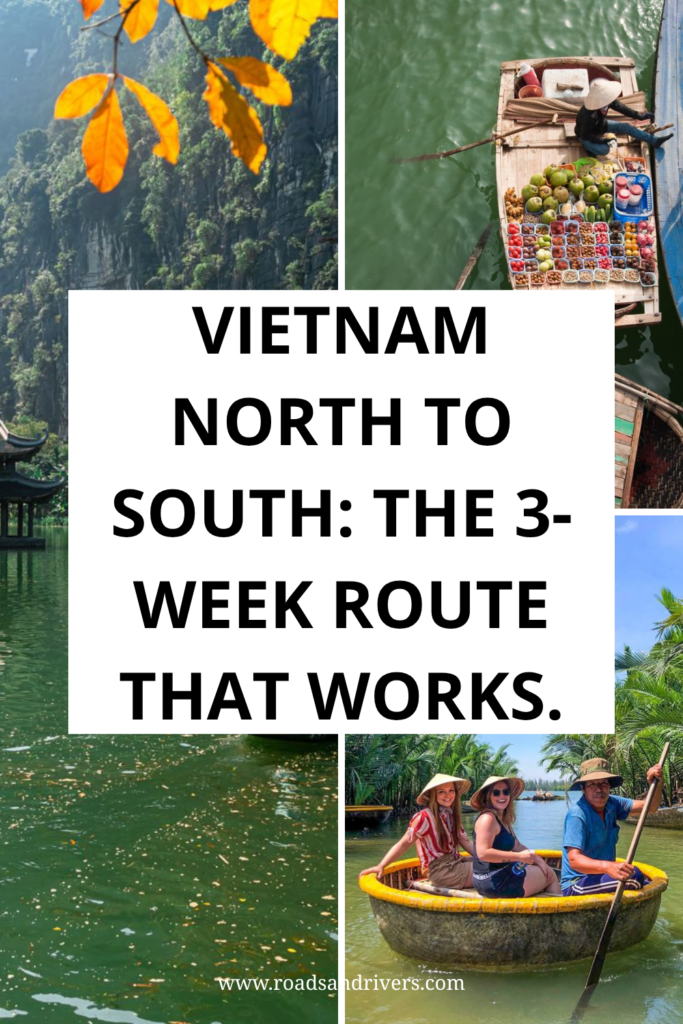
Vietnam North to South: The 3-Week Route That Works
For travellers with three weeks, this is the route that covers the essential Vietnam without feeling rushed.
Days 1-3: Hanoi. Old Quarter, egg coffee, bun cha, Temple of Literature, Hoan Kiem Lake at dawn.
Days 4-5: Ha Long Bay or Ninh Binh. Two-day cruise on Ha Long (or the cheaper Lan Ha Bay alternative) or a day trip to Ninh Binh with an overnight in Tam Coc.
Day 6: Travel day. Fly Hanoi to Da Nang (1.5 hours, $30-50). Transfer to Hoi An.
Days 7-9: Hoi An. Ancient town, cooking class, An Bang Beach, bicycle through rice paddies, lantern-lit evening walks.
Day 10: Hue day trip. Imperial Citadel, royal tombs, bun bo Hue for lunch. Return to Hoi An or stay overnight.
Day 11: Travel day. Fly Da Nang to Ho Chi Minh City (1.5 hours).
Days 12-14: Ho Chi Minh City. War Remnants Museum, District 4 street food, cu chi tunnels day trip, Binh Thanh cafes, District 1 walking.
Days 15-16: Mekong Delta. Overnight in Can Tho. Early morning at Cai Rang floating market. Coconut village boat ride.
Days 17-20: Phu Quoc. Fly from Can Tho or Saigon. Beach, night market, national park, snorkelling. Decompress.
Day 21: Fly home from Phu Quoc (direct international flights to several Asian hubs) or return to Saigon.
Key Takeaways
- Vietnam is best travelled north to south (or south to north). The country is long and narrow, and the route is linear. Use domestic flights to skip the longest overland stretches.
- Two weeks covers half the country well. Three weeks covers the full north-to-south route without rushing.
- The biggest itinerary mistake is cramming too many stops into too few days. Cut a destination rather than rushing through all of them.
- Street food is the heart of Vietnamese food culture and costs $1-2 per meal. Eating on the street is not a budget compromise; it is the best food in the country.
- Hoi An is the emotional centre of most Vietnam trips. Give it at least three nights.
Vietnam is one of those countries that changes your internal travel calibration. After three weeks here, eating a perfect bowl of pho for $1.50, taking a $0.60 motorbike taxi across a city, and sleeping in a beautiful guesthouse for $15 a night, every other destination feels slightly overpriced. That is not Vietnam being cheap. That is Vietnam being honest about what travel should cost when the priorities are food, scenery, and human connection.
Start in Hanoi. Eat the bun cha. Take the overnight train. Let the country unspool south.
What was your favourite stop in Vietnam? Drop it in the comments. Still planning? Ask anything below.
FAQ
How many weeks do you need for Vietnam?
Two weeks covers either the north (Hanoi, Sapa/Ha Giang, Ha Long Bay, Hoi An) or the south (Hoi An, Hue, Ho Chi Minh City, Mekong Delta, Phu Quoc) thoroughly. Three weeks covers the full north-to-south route comfortably. One week is possible for a focused trip covering Hanoi, Ha Long Bay, and Hoi An only.
Is Vietnam safe for solo travellers?
Vietnam is very safe for solo travellers, including solo female travellers. Petty theft (bag snatching from motorbikes) is the main risk in cities. Keep valuables in a front crossbody bag, use Grab instead of random motorbike taxis, and be alert in crowded tourist areas. Outside the cities, Vietnam is remarkably safe and welcoming.
What is the best time to visit Vietnam?
Vietnam has no single best time because the climate varies dramatically by region. The north is best from October to April (dry, cool). The centre is best from February to May (dry, warm). The south is best from December to April (dry season). March-April is the best compromise if you are doing the full north-to-south route.
How cheap is Vietnam for backpackers?
Vietnam is one of the cheapest countries in Southeast Asia. A realistic backpacker daily budget is $20-35 per day covering hostel accommodation, three street food meals, local transport, and basic sightseeing. Mid-range travellers spend $50-80 per day with boutique hotels and domestic flights.
Should you fly or take the train between cities?
Fly between Hanoi, Da Nang, and Ho Chi Minh City. The distances are enormous (Hanoi to Saigon is 1,700 km) and the Reunification Express train takes 30+ hours. Flights cost $30-60 and take 1.5-2 hours. Save the train for shorter scenic routes like Hue to Da Nang (3 hours along the coast).